
When students know their writing will be shared with others, something powerful happens. Writing stops feeling like an assignment and starts feeling meaningful. Publishing student work can transform how young writers see themselves—and inspire them to keep improving.
1. The Moment a Student Realizes Their Words Matter
When I was in first grade, my school had a spring program called YOUNG AUTHORS. Students in every grade were tasked with writing a story and publishing it for a writing competition within the school. I was a wildly creative child, storytelling with my dolls and stuffed animals for hours at a time. So my mom put a tape recorder by the door of my playroom and transcribed my playtime story into my first written piece—a short tale of about 20 sentences titled A Day at the Park.
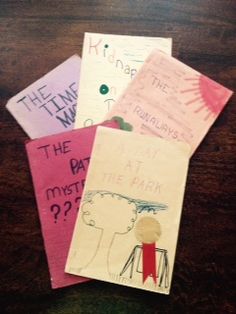
But it wasn’t just the fact that I had a story. My mom took the time to carefully fold and cut pieces of paper in half, roll the bright white paper around the cylinder of her typewriter, and plunk out my words. She left space at the bottom of each page for my illustrations. Before we finished, she gave it a bright yellow construction paper cover, and I carefully wrote out the letters of my title. At the bottom of the cover, I wrote the words: by Josie Bethke.
I was an author.
I had published my first story.
Later that week, the stories of my classmates adorned the hallways, and I admired the covers of the older students’ stories. They were longer and even more vibrantly decorated. They were amazing, and I knew I wanted to write stories like those.
2. Writing Feels Different When There Is a Real Audience
When we teach writing to kids, it can sometimes feel hollow. Writing can feel as though it is done in a vacuum—without a clear purpose.
The teacher reads it and gives it a grade. Then we move on to the next piece of writing, and the first piece is left behind.
But when writing is done to be published, suddenly there is lasting purpose. There is an audience who will read, enjoy, laugh…or maybe even cry…as they experience the words. Those words hold power and meaning.
Writing for a real audience increases effort, engagement, and pride.
3. Publishing Helps Students See Themselves as Writers
When we think of writers, we think of the ones who have authored the books we see on the shelves of libraries and bookstores. We picture books with interesting covers that hint at the story within the pages.
So when students publish their work in classroom anthologies, literary magazine collections, or even as a singular piece of work to share with others, that writing suddenly takes wings. Students begin to think of themselves as writers with great potential. Their identity shifts to include writer or author and they can imagine their work on those same shelves. Their work suddenly has value.
When we produce things of value, we gain confidence.
4. Confidence Leads to Better Writing
Now we have a positive cycle that leads to improved writing skills:
confidence → motivation → revision → stronger writing
When a student is motivated to continue writing and publishing, they willingly revise and edit. They want to learn the rules and conventions that produce strong writing and communication. Once confidence is built, the rest becomes exponentially easier to teach.
5. Why Many Students Never Get This Opportunity
Most students never have a teacher who prioritizes publishing student work. They rarely see their work in print or have the opportunity to share their writing in a meaningful way beyond a teacher or parent.
Publishing student work takes intention and effort—much like organizing a science fair requires planning and dedication. Student publishing celebrations and Young Author events deserve the same importance as middle school science or STEM fairs.
6. Giving Young Writers a Place to Share Their Work
After 10 years of teaching writing to homeschoolers, Online Scribblers made publishing student work a priority through our student literary magazine, Scribbler’s Ink. We invited all students to submit writing they were proud of, and for those who were hesitant, we suggested pieces they had written that would make terrific submissions.
That first year, we had so many submissions that we published a 100-page literary e-magazine and distributed it free to all families so they could enjoy and share it with relatives and friends. It is now an annual magazine that students look forward to and work toward all year long.
Each year, young writers experience the same pride I felt in first grade—seeing their words shared with a real audience.
7. Celebrating Young Writers
Publishing a piece of writing builds pride and motivates students to keep improving and learning new skills. It creates a culture that values the arts and recognizes their role in overall academic success.
When young writers know their words matter, they begin to write with confidence—and that confidence changes everything.